Latest News
Bringing the latest news and gossip from
Ireland and around the world
The rare Silver-sided Nomad Bee was spotted in Co Offaly [pic: Biodiversity Ireland]
A critically endangered species of bee has been spotted in Ireland for the first time in 26 years. The Silver-sided Nomad Bee was found in Co Offaly on 11 August by net-sweeping Devil's-bit Scabious, a common habitat for the rare species. There have been just seven confirmed historic records of the bee for the island of Ireland.
It is the first time the Nomad bee has been seen in Co Offaly. Previous sightings have been confirmed in counties Galway, Laois and Carlow. The Nomad Bee flies between mid-July and mid-September. Nomad bees are 'cleptoparasites’, meaning that, similar to a Cuckoo bird, they lay their eggs in the nest of a host species. Their larva then steals host resources, such as collected pollen, to complete development.
This record follows on from new site records of the Small-scabious Mining Bee by the National Biodiversity Data Centre in August 2022, which followed a tip about the new site from a local wildlife recorder. Both species are assessed as ‘Critically Endangered’ on the Regional Red List of Irish Bees. The Silver-sided Nomad bee and Small-scabious Mining Bee are two of the 15 rarest and most threatened pollinators that the All-Ireland Pollinator Plan will be monitoring from 2026 to 2030.


A simple tubular trap placed in front of honey bee hives cut yellow-legged hornet attacks by about fivefold in Spanish field tests, helping bees forage normally while capturing the invasive predator and limiting impact on nontarget species. Shown here, the trap tested by researchers in a new study is a modified version of a trap designed by Spanish beekeeper Koldo Belaska. It features a horizontal mesh tube that is placed in front of entrance ways to hives, with vertical “chimney” tubes at each end for trapping hornets. (Photo originally published in Bas et al. 2026, Journal of Economic Entomology) For the full story, use the link below
https://entomologytoday.org/2026/08/20/koldo-belaska-trap-protect-honey-bee-hives-yellow-legged-hornets/
European Beekeeping Association: Free download
(Please use the link below)
The European Parliament has approved an ambitious position ahead of talks with EU ministers on the overhaul of European honey marketing rules in a bid to stem floods of counterfeit imports mainly coming from China.
More transparent country of origin labelling on all imported honey is the main proposed tweak to the Commission’s revision of the so-called Breakfast directives, European lawmakers agreed in a plenary vote held in Strasbourg on Thursday (12 December). The main objective of the Parliament’s position is to reverse a spike in fraud affecting the honey sector.
MEPs specified that countries of origin should be mentioned in descending order on honey labels, indicating their respective share in percentage of the weight contributing to each pot.
A proposal to reform the ‘Breakfast directives’ was put forward by the Commission last April as part of the attempt by the European Commission to update the EU marketing standards of breakfast foodstuffs such as fruit juices, jams, and honey, some of which were more than 20 years old.
In March 2023, the EU Anti-Fraud Office (OLAF) issued a shock report concluding that 46% of honey imported from third countries into the Single market was suspected of being non-compliant with the bloc’s legislation. For the full article, press the link below.
https://www.euronews.com/embed/2433482

More funding announced in battle to eradicate yellow-legged hornets
More than 30 queen hornets and 22 nests have been located and destroyed so far in Auckland. Photo: Biosecurity NZ
Millions of dollars are being redirected by the government and sent instead to combat the growing number of invasive, predator hornets being found in Auckland.
Since the first yellow-legged hornet was found on the North Shore, 37 queens have been found in total and 28 nests.
Biosecurity Minister Andrew Hoggard said the government has committed $12 million to cover the cost of the response to 30 June 2026.
"Action now will be the most cost effective way to get on top of this rather than any delay," Hoggard said while announcing the funding at MPI offices in Auckland.
Officials were "pretty certain" the hornets are from a single incursion, the minister said.
"So, it's important that we get on top of this pest and eliminate it, particularly, we're pretty certain that this is just a single incursion," Hoggard said.
"And so action now will be the most cost-effective way to get on top of this rather than any delay."

Contrary to popular depictions of bee nests as large, intricate hives that hang from trees, the majority of bee species — about 90% — are actually solitary and build their nests in the ground or within rotting logs and the stems of plants.
But researchers recently discovered what is perhaps one of the most peculiar nesting spots: Inside a limestone cave on the Caribbean island of Hispaniola, a hoard of fossilized bones — some from now-extinct animals — was home to tiny ancient bee nests built within the empty tooth sockets. It is the first time bees have been recorded using bones to nest and lay eggs, according to a study published Tuesday in the journal Royal Society Open Science.
“It was very surprising, because you never find invertebrates there — you find snails, but you don’t find insects,” said lead author Lázaro Viñola-López, a postdoctoral researcher at the Field Museum of Natural History in Chicago. “Usually, what you find in this cave are rodents, birds, and all that fauna. So, finding evidence of ancient bees in those cave deposits was very exciting. The first time we have that in the Caribbean.”
The findings help to fill a gap in the fossil record since all other bee fossils described in the Caribbean were discovered within amber and are much older, dating back around 20 million years, Viñola-López explained.
Following the success of the inaugural Forum in 2024, the National Biodiversity Data Centre organised the second Shared Island Biosecurity and Invasive Species Forum, which was held in Belfast on the 4th November 2025. This year’s event once again brought together representatives from across sectors: industry, public bodies, and non-governmental organisations, to strengthen collaboration on invasive species and biosecurity across the island of Ireland.
The one-day programme featured a rich mix of expert presentations, interactive workshops, and open feedback sessions. An opening address was given by Minister Andrew Muir MLA, Minister for Agriculture, Environment and Rural Affairs in Northern Ireland and closing remarks were provided by Minister Christopher O’Sullivan TD, Minister of State at the Department of Housing, Local Government and Heritage.
The Forum provided a valuable space for exchanging ideas, sharing knowledge, and fostering cross-sector dialogue. Stakeholder engagement remains central to shaping effective, inclusive, and forward-looking policies and actions to address invasive species threats.
Invasive species continue to be one of the most significant drivers of biodiversity loss worldwide. By building on the momentum of the 2024 Forum, this second gathering aimed to deepen our shared understanding of biosecurity challenges and opportunities, helping to protect Ireland’s unique ecosystems and reduce the economic risks posed by invasive species.
A huge thank you to everyone who joined us on the day and supported the Forum. A summary of the Forum, along with links to presentations and workshop notes, is available here:
https://invasives.ie/about/shared-island-biosecurity-and-invasive-species-forum-2025/

By Steve McGrath
It’s bonfire night, and in my small part of the southeast of England, we have yet to experience a ground frost. That’s the latest that I can remember. Some colonies are still finding pollen, which bodes well for the restart of egg laying in January, and there was definitely a strong ivy flow, which may prove to be a blessing or a curse (Roger Patterson explains why here: https://youtu.be/qwqS_v9Q3OU).
Although recent temperatures, at 15 degrees or more some days, would have allowed me to go into the hives, there is now no reason for me to do so. I’d rather leave the protective propolis envelope intact and not needlessly disturb the bees. I can tell all I need to know over winter by examining the insert trays each time I go to check and heft the hives.
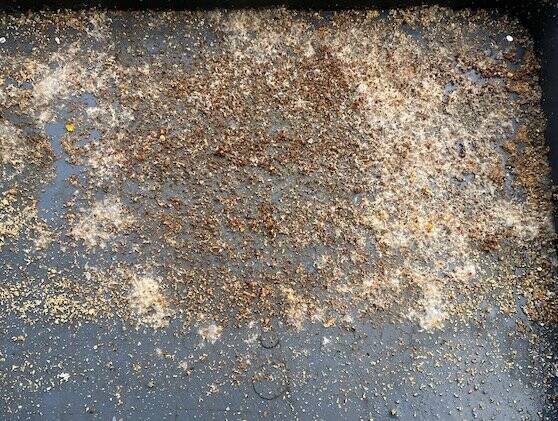
I leave my insert boards and trays in place all year round, allowing me to do varroa mite counts and record evidence of pupal parts as varroa-resistant bees chew out infected pupae, whatever the season. During winter, it also tells me what else is going on inside the hives and ensures there are no cold drafts from underneath.
I checked in on some of my apiaries today, and here’s what I learned from the bottom boards:
- Daily varroa mite drops in my best performing colonies average fewer than one a day, and only slightly more in most others. These are very low counts for the time of year.
- There was a burst of brood during the ivy flow, but that is now petering out. During this brood period, bees were chewing out varroa-infected pupae as evidenced by pupal parts among the brood capping debris.
- Some colonies have moved on to their stores as evidenced by lines of white wax cappings on the insert boards towards the sides of the brood box, although hives are still hefting heavy.
Without opening the hives, I know what the colonies have been up to, where the cluster is positioned, and I know that they continue to control their varroa populations. To do an accurate mite count and look among the debris in more detail, I take a photo of the insert tray (slugs and all) with my phone, and then I can blow it up and look at sections once I’m in the warmth.
If you weren’t able to visit the BIBBA stand at the National Honey Show, then we have released a new video to help beekeepers identify the signs of the key varroa-resistant traits of uncapping worker brood and chewing out infected pupae. This shows examples of pupal parts on the bottom boards. You can watch the video here: https://youtu.be/JjQjKI_jl5I.
It was fantastic to meet so many beekeepers at the show who are starting out on their varroa-resistant journeys, and more who are some way down it. There has been a complete change in attitudes and understanding over the past couple of years. BIBBA and the team at www.varroaresistant.uk will continue to provide resources to help you on your own journey. If you haven’t already, you can sign up for a supportive email journey at https://bibba.com/varroa-resistance/.
If you have read previous varroa-resistant articles in BIBBA Monthly, you’ll know that in the summer, I re-queened several ‘mite breeder’ colonies that weren’t varroa resistant with new queens from varroa-resistant queen lines. I observed that uncapping and chewing out, which had previously been absent, started as soon as the new queen’s offspring became dominant in the hive. Average daily mite drops, which had been constantly increasing, levelled off.
Checking the insert trays on those colonies now, the mite drop is higher than in my long-term varroa-resistant colonies (currently dropping fewer than 1 a day), but at between 3.4 and 4.6 a day over the last three weeks, I am very positive. This is a low mite count for the time of year. Amongst the debris were pupal parts - the tell-tale sign that infected pupae are still being chewed out. These previously varroa naïve colonies are now waging war on the mites, led by a varroa-resistant queen line.
Lessons from New Research NOVEMBER 2025
Summary
A 2025 study in Apidologie by Parenzan et al. reveals that Varroa destructor mites can survive far longer on honey-bee larvae than previously believed — typically 45-50 days but up to 100 days has been observed. The findings reshape how we think about brood breaks, frame transfers, and quarantine in Varroa resistant beekeeping.

The Take-Home Message from the paper
Varroa mites can persist on larvae far longer than expected — sometimes for months. This explains why colonies often rebound quickly after short brood breaks or frame transfers. Breeders and practical beekeepers can use this knowledge to tighten brood management, strengthen quarantine, and refine selection for brood-based resistance.
Building on such scientific insights brings us one step closer to robust, regionally adapted bees capable of thriving with minimal treatment — the very goal at the heart of BIBBA’s philosophy.


And, very finally, a word of caution
It’s not always prudent to base your beekeeping practices on the outcome of a single piece of scientific analysis. In this case, extended and complete brood breaks may stress the bees unnecessarily and possibly distort your understanding of any natural Varroa resistant traits within the colony.
.
Sustainable Honey Bee Breeding: A Scientific Guide for Future Beekeeping
Cecilia Costa, Marina Meixner, Norman Carreck, Aleksandar Uzunov & Ralph Büchler (Eds.) Springer Nature, 2024

"Sustainable Honey Bee Breeding confirms that the future of apiculture will not be built on imports or chemical dependency, but on patient, locally focused selection.
For BIBBA readers, it feels less like a new idea than a vindication of everything the Association has stood for since its founding - working with nature to create stronger, self-sustaining bees."
This new volume represents a major milestone in the movement toward locally adapted and resilient bees. Drawing together over 30 contributors from 16 countries within the COLOSS network, it unites two decades of collaborative science into a practical, forward-looking guide for modern apiculture.
The book’s central argument will sound familiar to BIBBA members: that sustainability begins with local adaptation. The editors show, with convincing data and field examples, that honey bee populations shaped by their regional environment are more resilient, productive and harmonious than imported stock. Early COLOSS studies into overwintering losses revealed “bee origin” as a decisive factor - colonies of local lineage consistently survived better. The message is clear: the future of beekeeping lies in improving what is already well adapted to our own conditions.
The first section tells the story of Apis mellifera’s evolution and its long relationship with humans. It explains how diverse ecotypes across Europe co-evolved with their environments, and how that diversity forms the genetic foundation for today’s breeding work. The book goes on to highlight free-living populations - unmanaged colonies that continue to survive Varroa without chemical treatment. These bees, often found in forests or rural landscapes, demonstrate that natural selection can still operate effectively. Their example challenges breeders to align human selection with natural adaptation rather than working against it.
One of the most valuable parts of the book is its clear discussion of Varroa resistance. The editors summarise research into traits such as hygienic uncapping, recapping, suppressed mite reproduction and grooming behaviour. They stress that resistance is not a single trait but a cluster of adaptive behaviours best understood (and selected for) within the local context. Their conclusion could easily serve as a BIBBA motto: resistance cannot be imported; it must be bred locally.
The second half of the book turns to practical breeding methods - performance testing, data recording, economic considerations, and above all, queen rearing. These chapters are an invaluable reference for any bee improvement group. They describe workable systems for small and large-scale operations alike, with sound guidance on maintaining genetic diversity and controlling mating. Collaboration is emphasised throughout: breeding, the authors remind us, is not a solo pursuit but a cooperative enterprise - a principle long upheld by BIBBA.
Accessible yet rigorous, the book bridges science and practice beautifully. Its blend of research, field experience and case studies makes it suitable for both professional and amateur breeders.
20% off discount coupon review by Karl Colyer