Immediate Action Required
- Do Not Move Equipment: Close the hive immediately and avoid moving bees, frames, or gear to prevent spreading the spores.
- Notifiable Disease: American foulbrood is legally notifiable in many jurisdictions. Contact your local agricultural department or a regional bee inspector right away for guidance.
Key Visual Signs
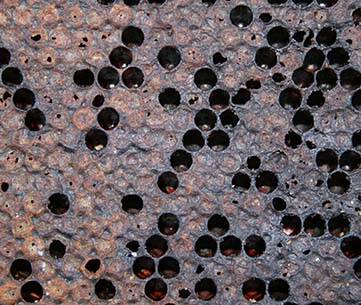
- Brood Pattern: Patchy, uneven distribution of capped and open cells instead of a solid, neat pattern.
- Cell Cappings: Sunken, darkened, or greasy-looking caps with tiny, jagged holes chewed by bees.
- The Roping Test: Uncapping a suspect cell reveals a gooey, coffee-brown larva that stretches into a sticky thread (up to 30 mm) when poked and pulled out with a matchstick or toothpick.
- Pupal Tongue: In advanced cases, a dead pupa's fine tongue sticks straight up toward the top of the cell roof.
- Hard Scales: Dried remains turn into dark, brittle scales tightly glued to the lower cell wall that are difficult to remove.
- Odor: A foul, putrid, or dead-decay smell in severe cases.
If you are still unsure, speak to another beekeeper or to us for a second opinion. Remember biosecurity and hygiene. If it is confirmed, contact the Department of Agriculture, Food and the Marine (DAFM) via email at beekeeping@agriculture.gov.ie, or send diagnostic brood comb samples directly to Dr. Mary Coffey at the Plant Health Laboratory, Backweston Laboratory Campus, Celbridge, Co. Kildare, W23 X3PH.
This is a notifiable disease in Ireland